
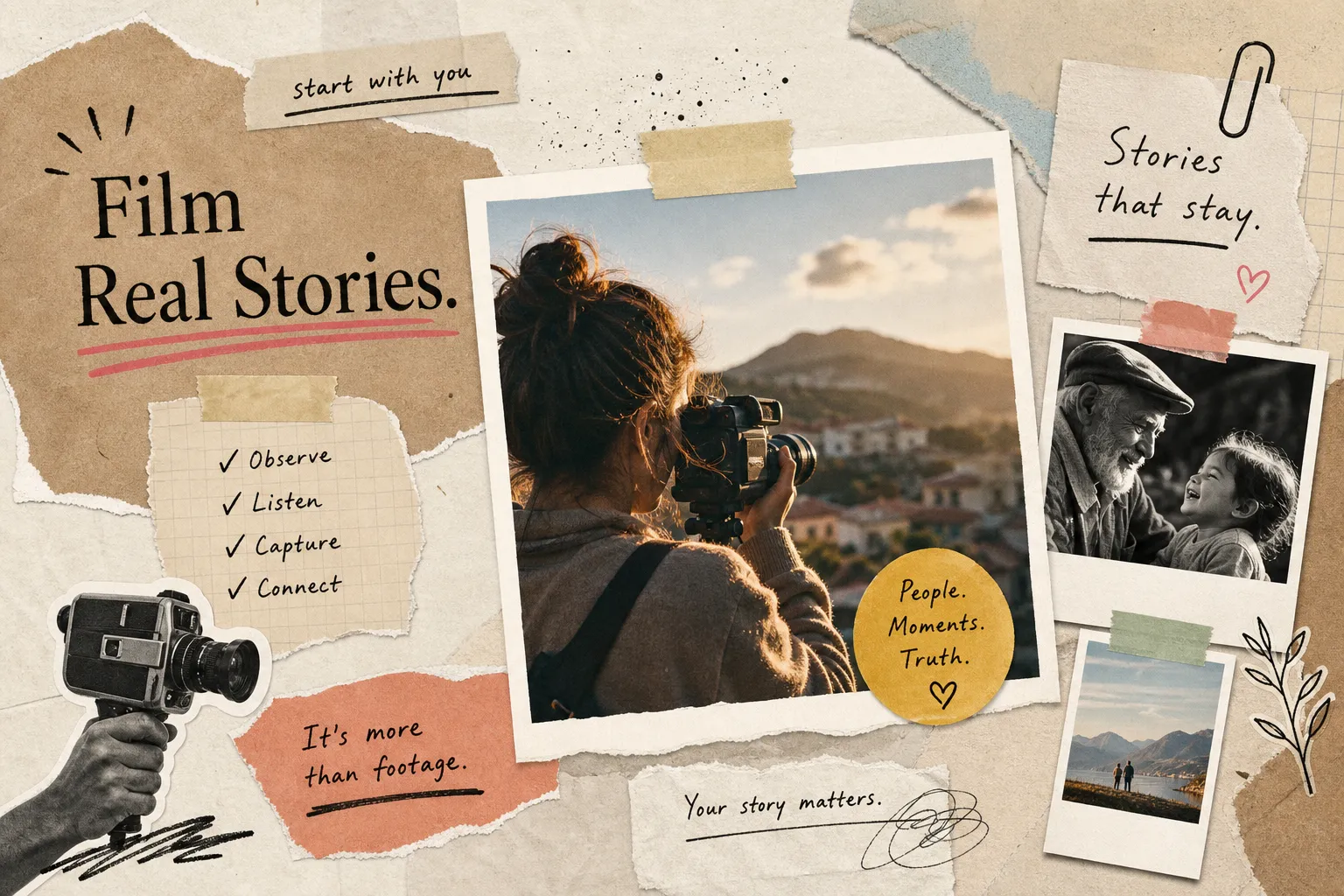
Most people who set out to film a loved one's life story aim to create a personal documentary but end up with something closer to a video scrapbook: well-intentioned, maybe sweet, occasionally watched on a rainy Sunday, and then forgotten in a drawer.
The gap between "footage of real life" and a film that makes grown adults cry at a kitchen table comes down to a handful of specific principles. Once you understand them, you start seeing the difference everywhere.
This guide walks through the core elements of compelling autobiographical filmmaking, from how to shape your story to why the way you conduct an interview changes everything that ends up on screen.
What actually makes a personal documentary different from home video
The foundational insight, and it's one that catches a lot of beginners off guard, is this: even though a memoir film centers on you or your family, audiences come in with a built-in resistance to self-centeredness. Nobody sits down to watch someone else's highlight reel. What they'll watch, and rewatch, is a story.
Filmmaker and educator Doug Block puts it plainly in his rules for this genre: you're not really you. You're a character in a story, and that story needs a journey, obstacles, and a transformation.
The difference between recording events and constructing meaning is enormous. Home video captures what happened. A first-person documentary asks why it mattered, who was changed by it, and what it cost. That shift in framing changes everything from the questions you ask to the footage you include in the edit.
The storytelling principles that separate compelling films from forgettable ones
Vulnerability isn't a bonus you sprinkle in at the end. It's the actual work. Authentic storytelling in this genre means showing the difficult, contradictory, and occasionally unflattering truths, not just the polished version you'd put in a Christmas letter. Audiences trust a subject who admits to complexity far more than one who presents only their best self.
Context is what turns a private story into a shared one. A memoir film about grief only resonates when it connects that grief to something larger, a generational pattern, a cultural moment, a fear every human being carries. A personal documentary about one family's immigration story, for example, gains power the moment it touches the universal experience of belonging and loss.
How meaningful interviews become the emotional engine of your personal documentary
The instinct for most beginners is to prepare a formal list of questions and check them off one by one. It's understandable. It feels organized. But that format almost always produces answers that sound like answers: polished, careful, and emotionally flat. What you want is a conversation.
Where you conduct the interview matters more than most beginners realize. A meaningful, familiar space—a kitchen, a workshop, a front porch—gives the subject a sense of safety and grounds them in their own story. Don't shoot against a blank wall because it feels "neutral." That blankness communicates nothing.
Visual composition and production elements that make a life story film cinematic
The most common mistake in first-person filmmaking is over-relying on voiceover to explain what the audience should be feeling. Strong visual storytelling lets footage, photographs, and environment carry the emotional weight. The principle is simple: show as much as possible, tell as little as possible.
Archival materials do something an interview alone cannot: they collapse time. When a 78-year-old subject's face appears next to a photograph of them at 22, something clicks in the viewer. The gap between those two images is the story. Integrate photographs, home videos, letters, and physical keepsakes not as decoration but as narrative tools.
Narrative structure for a personal documentary that has emotional shape
Setup, confrontation, resolution. This three-act structure works for real life just as well as it works for fiction, because it mirrors how human beings actually experience change. The subject's world as it was, the complication or challenge that defined them, and how they were transformed by it.
For most life story films, a linear chronological approach is the clearest path. The timeline itself carries meaning. Someone's childhood shapes their choices as an adult, which shapes what they pass down to their children, and following that thread in order helps the audience feel the weight of accumulated time.
When a professional filmmaker makes the difference for legacy work
There's an honest difference between a well-intentioned iPhone interview and a cinematic legacy film designed to be passed down through generations. This isn't a criticism of DIY approaches. It's an accounting of what's actually possible at different levels.
Story & Legacy Films was built specifically for this kind of work. Based in Boise, Idaho, and serving clients nationwide, the studio was founded by filmmaker Kedrick around a single question: what does it take to capture someone's life story in a way that feels genuinely like them?
The answer became a guided, conversation-first process, one that replaces stiff scripted interviews with natural dialogue designed to draw out authentic personality, humor, and emotion.
Start with one good question
A personal documentary is one of the most powerful things a family can create, but only when it's built around a story, not just footage. Anyone can start this process today by asking one good question of someone they love. Not "tell me about your life." Something specific: "What's the hardest decision you ever made?" or "What do you want your grandchildren to know about where you came from?"
For families ready to do this right, Story & Legacy Films offers a full-service process designed to make the experience feel less like a production and more like a conversation worth having.
Frequently asked questions about personal documentary filmmaking
What is personal documentary filmmaking?
Personal documentary filmmaking is the practice of crafting a structured, narrative-driven film about a real individual or family. Unlike home video, it applies the tools of narrative cinema: character development, a defined arc, intentional interviews, and deliberate visual choices.
How is a personal documentary different from a home video?
Home video captures what happened. A personal documentary asks why it mattered and who was changed by it. The difference lies in intention and structure.
Do I need professional equipment to make a personal documentary?
Not necessarily, but audio quality is non-negotiable. Viewers will tolerate imperfect video far longer than they'll tolerate dialogue they can't hear.