
Legacy Video: What It Is, What It Costs, and Who to Hire
Don’t Let Their Stories Fade!
Download the free Legacy Story Starter Guide — a simple reflection guide to help you uncover the memories, lessons, values, and messages your family may one day treasure most.
Picture a family gathered in a living room after a grandmother's funeral. Someone pulls out a phone to play an old voicemail, just to hear her voice one more time. The laughter, the stories, the way she described crossing the country with $40 in her pocket and a suitcase that wouldn't close properly, none of it was ever recorded.
That moment, that specific ache of realizing a whole life has slipped away unpreserved, is what drives families to search for a legacy video filmmaker.
At Story & Legacy Films, we've sat with dozens of families who came to us after nearly losing someone's story forever, and just as many who were wise enough to act while they still could.
This article explains what a legacy video is, what it typically costs, how production works, and what to ask before you hire anyone. Getting started is simpler than most families expect.
"A recording captures words. A legacy film captures a person."
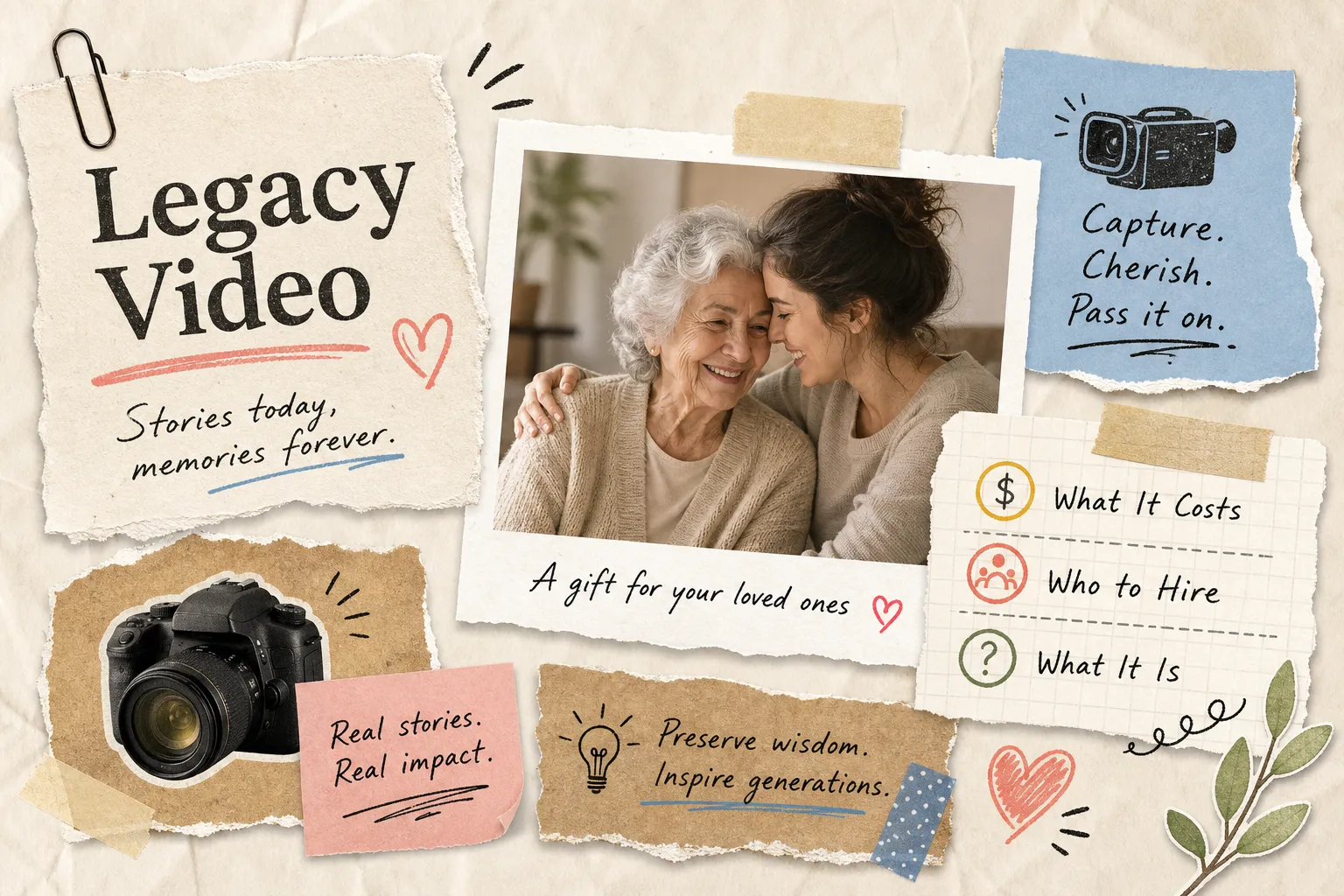
What a legacy video is (and why it's nothing like a home movie)
A legacy video is a short, personal documentary film that captures an individual's life stories, values, and hard-earned wisdom entirely in their own voice. It weaves together filmed interviews with archival photos, letters, and home footage to create a cinematic time capsule for the people who will inherit this person's memory.
Think of it as an intimate PBS documentary about someone you love, not a slideshow, not a highlight reel. The subject speaks directly to the camera, telling the full story, including the hard parts, not just the polished version they share at dinner parties.
What separates a life story video from home movies comes down to craft and intention. Home recordings capture moments; a legacy documentary captures meaning. Shaky footage, competing background noise, no narrative arc, and no one asking the right questions to draw out the important memories, that's what most families end up with when they try to do this themselves.
A professional production brings three-camera setups, clean audio, professional lighting, and a skilled interviewer who knows how to guide a conversation toward the stories future grandchildren will actually want to hear.
It also helps to understand how a video memoir compares to a written memoir or photo album. Written memoirs and photo books capture facts and images, but neither preserves a person's voice, their specific laugh, the way they pause before describing something difficult. A video memoir is the only format that keeps a person's full personality intact for the people who will never get to sit across the table from them. That distinction matters more than most families realize until it's too late to act on it.
Some families also use these terms interchangeably: oral history video, family history video, life biography video, or memory video. The format varies slightly depending on scope, a single-subject interview versus a multi-generational family history video with several subjects, for example, but the core purpose is the same: preserving a real person's story before it's gone.
Why so many families are creating legacy films right now
Baby Boomers are now in their late 60s to mid-80s, and this group represents the largest wave of people with extraordinary lived history who are still able to tell their own stories. Many of them survived wars, built businesses from nothing, immigrated with everything they owned in one bag, or raised families through genuine hardship.
That firsthand memory is irreplaceable, and the timing matters more than most families want to admit. The window is open right now, and it does not stay open indefinitely.
What a legacy documentary actually preserves is harder to put on a list. It's the values a person lived by. The way they handled failure. The advice they would give their grandchildren if they could sit down with them decades from now. These are the things that shape family identity across generations, and they exist nowhere except in the memory of the person who lived them.
Once that person is gone, the stories go with them. No estate, no photo collection, no scrapbook brings them back.
How professional legacy video production works, start to finish
Before a camera is ever turned on, a reputable filmmaker begins with a discovery call and story-mapping session to understand who the subject is, what experiences shaped them, and what the family most wants preserved.
At Story & Legacy Films, this guided preparation process also gets the subject emotionally ready for filming day, so they arrive relaxed and able to open up naturally rather than nervous about "performing." During this pre-production phase, archival photos, letters, and old home movies are collected, and Story & Legacy Films handles all the photo scanning so families don't have to figure out digitization on their own.
Filming day looks different from what most people expect. A professional crew sets up a multi-camera arrangement with dedicated lighting and audio in a comfortable, familiar setting, often the subject's own home. The interviewer uses an open-ended, guided conversation approach rather than a scripted Q&A. The goal is to get the subject talking naturally, laughing, tearing up, pausing to find exactly the right word. That authenticity is what makes the final film feel like a true portrait of a person rather than a formal presentation.
The edit is where a raw conversation becomes a film. Editors remove tangents and the interviewer's voice, weave in archival photos and video synced to the spoken story, and choose music that complements the emotional tone without ever overpowering the subject's voice. Most professional projects deliver the final edited film within six to eight weeks of filming. Many filmmakers also send the family a raw, unedited version first as a reference copy, so nothing from the interview is ever truly lost.
What a legacy video typically costs and what you get
Legacy video pricing spans a wide range, and it helps to know what each tier actually buys you.
Entry-level and budget packages
Entry-level packages, typically priced between $495 and $1,500, usually include a 30- to 60-minute interview, basic editing, a selection of digitized photos, and a digital file or USB drive. These are serviceable for families working with a tight budget, though production quality and interview depth vary considerably at this level.
What the mid-range tier includes
Most families fall into the mid-range tier, roughly $1,700 to $6,300. These packages add a multi-camera setup, professional lighting and audio, 60 to 120 minutes of interview time, motion graphics, and a refined final edit running anywhere from 30 to 75 minutes. Story & Legacy Films' packages sit in this range, offering tiered options including The Heirloom (up to a 30-minute film) and The Memoir (up to a 75-minute film with location b-roll and custom USB drives). This tier represents the sweet spot between cinematic quality and accessible pricing for most families.
What premium pricing adds
Premium and documentary-tier projects, priced from $7,500 into the $25,000 range and beyond, are designed for families with particularly rich or complex stories: multiple filming days, layered storylines, broadcast-quality color grading, full transcripts, and extended runtimes. These are closer to feature-length documentary films and suit subjects with unusually layered personal or professional histories.
Beyond the film itself, ask specifically about physical deliverables. The best packages include:
- Custom USB drives in keepsake boxes, engraved with the subject's name
- Digital download links for easy sharing with family members across the country
- Scanned and lightly restored archival photos embedded in the final edit
- A raw unedited version of the full interview for the family's records
Story & Legacy Films includes physical keepsakes alongside digital delivery, so families have something tangible to hold on to, not just a file sitting in someone's downloads folder, because a heirloom video should feel like one.
In-person vs. remote filming: what to consider
In-person production delivers the highest cinematic quality available: professional cameras, controlled lighting, dedicated microphones, and a crew that can adjust the environment in real time. For families who want a film that truly looks and sounds premium, in-person is the clear choice. The physical presence of the interviewer also creates a more natural rapport that draws out better, more emotionally honest stories than a screen-to-screen conversation typically does.
Remote production via video conference has become a legitimate option, particularly for elderly subjects who cannot travel or for families spread across the country. The trade-off is real: audio and video quality depend heavily on the subject's home setup and internet connection, and even with the best settings enabled, remote footage does not match the clarity of a local professional recording. Remote options work best for families prioritizing accessibility over production polish, and some filmmakers offer a hybrid approach, doing remote interviews combined with in-person filming for select portions of the project.
Questions to ask before you hire a legacy filmmaker
The single most important question is about interview methodology. Ask how many legacy interviews the filmmaker has conducted and whether they have specific training in working with elderly subjects or navigating emotionally sensitive topics. Ask whether the question list is customized to the individual's story and whether the subject receives a pre-interview questionnaire to help them prepare. A filmmaker with a real methodology will have clear, specific answers here. One who hands you a generic question list and calls it a day will not.
Rights, storage, and long-term access deserve equal attention. Clarify who owns the copyright to the raw footage and the final film. Ask whether the family can share the video freely after delivery or whether there are usage restrictions. If the company hosts the video on their platform, find out whether that hosting expires or requires an annual fee, and ask explicitly what happens to the footage if the company closes. None of these are uncomfortable questions, they're just the right ones to ask.
On the technical side, confirm the final film is delivered in at minimum 1080p resolution, ideally 4K, in standard formats like MP4 or MOV. Ask whether a physical copy is included in the package or treated as an add-on. Confirm the production timeline from filming to final delivery and whether the family receives a review round before the edit is locked. A reputable company walks you through all of this clearly before you sign anything.
Your family's story deserves more than good intentions
The families who act on this are not the ones with perfect timing. They are the ones who decided the story was worth capturing before it became a regret.
Starting a legacy video project is one of the few decisions families look back on without a single reservation, because the alternative is that grandmother's voicemail, playing on a phone in a quiet living room, the only proof left that she was ever here.
Story & Legacy Films guides families through this entire process, from the very first conversation about what to include, through filming day, to the moment the finished film arrives at your door.
If you have a parent, grandparent, or loved one whose story deserves to be preserved, reach out to start the conversation. The window is open right now, and that's exactly the right time to use it.
Let's Talk About Your Family's Story
Fill out the form below to start the conversation and see if a legacy film is the right fit.
Preserve Your Family's Legacy
Every family has a story worth telling. Let us help you preserve yours in a cinematic, guided legacy film.
Visit Story & Legacy Films