
Hire a Legacy Filmmaker or DIY? The Honest Tradeoffs
Picture this: a smartphone propped against a coffee mug, your dad sitting stiffly at the kitchen table, and you on the other side asking, "So... what was your childhood like?" Thirty seconds of silence. He shrugs. You both laugh nervously.
The clip gets saved to your camera roll, buried somewhere between a grocery list photo and a blurry dog picture, and never watched again.
That's not a legacy film. That's a missed opportunity dressed up as good intentions.
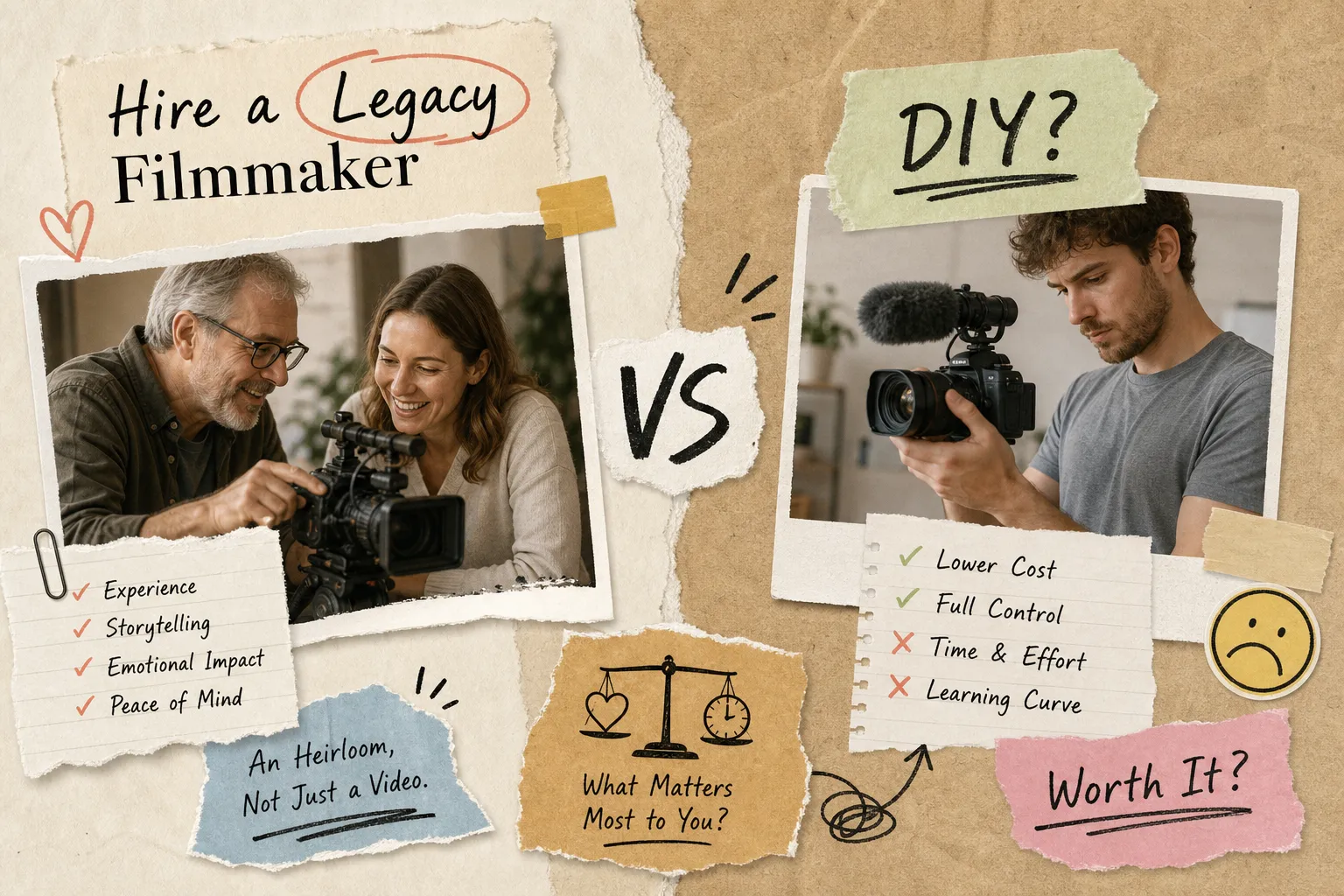
If you're weighing whether to hire a legacy filmmaker vs. record yourself, you've probably already hit the same wall: what do you actually want the final result to be? Something that gets watched, rewatched, and passed down for decades, or something that checks a box?
The honest answer depends entirely on that question, and this article walks through the real tradeoffs so you can decide with confidence.
Here's what we'll cover: storytelling quality, technical production, emotional facilitation, cost on both sides, and a practical framework for making the call.
Hire a legacy filmmaker vs. record yourself: why outcome matters more than budget
Most people frame the hire-a-legacy-filmmaker-vs.-record-yourself question as a budget decision. It's not. It's a question about what kind of artifact you want to leave behind.
A home recording and a professional legacy film are genuinely different things, and that difference becomes obvious years later when someone presses play. A recording captures words. A legacy film captures a person.
The distinction lies in structure, emotional arc, pacing, and the context woven throughout. Some legacy filmmakers, for example, begin with a guided discovery call and story-mapping session before a camera ever enters the room. That pre-production work shapes what gets captured, which chapters of a life get explored, and which emotional threads get followed. The camera is the last part of the equation, not the first.
There's also a watchability factor that rarely gets discussed upfront. Poor audio, awkward silences, flat lighting, and a conversation that wanders without structure make a recording genuinely hard to sit through. The goal isn't just capturing words. It's creating something the next generation will actually want to watch more than once.
The storytelling gap: what a trained interviewer actually unlocks
Here's the part that surprises most people. The single biggest difference between a professional legacy film and a DIY oral history recording isn't the camera. It's the interview.
A skilled interviewer draws out stories that a well-meaning family member on the other side of a phone screen simply cannot. Family-run recordings tend to stay surface-level because the person asking questions is too emotionally close, too hesitant to push on something tender, or lacks the technique to follow a thread when it appears.
The pattern is predictable: questions get answered in two sentences, nobody asks "what happened next?" or "how did that feel?", and the session ends without ever reaching the real story underneath.
Professional legacy filmmakers use four follow-up techniques that transform a vague memory into a vivid scene: sensory recall ("what did that place smell like?"), emotional follow-up ("how did that feel in the moment?"), character expansion ("who else was there?"), and story continuation ("what happened after that?").
These aren't tricks. They're the difference between a subject saying "we didn't have much money growing up" and spending 20 minutes describing the specific Saturday morning they realized it, and what their mother said to make it okay. That second version is what families treasure for generations.
At Story & Legacy Films, the interview process is built around a guided conversation methodology designed to make subjects feel at ease, as if they're talking to an old friend rather than performing for a camera. A pre-production call before filming helps identify the key chapters of a person's life, so the on-camera conversation has direction and depth from the very first question.
What separates a skilled interviewer from a well-meaning family member
The techniques above can be practiced, but comfort with emotional follow-up takes time to develop. A professional legacy videographer has typically conducted dozens of these conversations and knows how to hold silence, redirect gently when a subject stalls, and recognize when a small detail is actually the doorway into a much larger story. That instinct isn't taught in a single session, it's built through repetition.
What professional audio, video, and a multi-camera setup actually deliver
Technical quality shapes emotional impact more than most people expect. A stunning story told in bad audio with harsh, flat lighting feels cheap. It changes how a viewer receives the content, even if they can't articulate why.
A professional 3-camera setup delivers things a single smartphone simply cannot. Multiple angles allow for natural editing cuts without stopping the interview, which means the conversation flows uninterrupted. Shallow depth of field keeps the subject visually present and warm against the background rather than flattened into it. Professional lighting makes a 75-year-old face look dignified and alive rather than washed out by a window or underlit in shadow.
A single front-facing phone camera offers none of that, no depth separation and no way to edit around pauses, coughs, or the moment the subject glances away.
Audio quality, though, is the factor that kills more DIY family archive videos than any other. Bad video is distracting. Bad audio is unwatchable. The difference between a camera's built-in microphone and a professional lavalier or shotgun mic running into a dedicated recorder is substantial, and it's very difficult to fully fix in post-production. If the audio is muddy, distant, or full of room noise, no amount of editing saves it. This is the one technical element worth taking most seriously if you decide to record it yourself.
The technical checklist for professional-quality results
Whether you hire a professional or go the DIY route, these elements determine whether the final film is watchable a decade from now: a dedicated audio source (not the camera's built-in mic), controlled lighting that doesn't shift during the session, stable framing that doesn't require a hand on the camera, and a backup recording running throughout. Miss any one of these and the footage becomes difficult to work with in the edit.
Hire a legacy filmmaker vs. record yourself: the real cost on both sides
Professional legacy filmmakers in the United States typically price by project scope rather than hourly rate. Entry-level packages, usually a single-location interview with lighter editing, run $1,500 to $5,000. Mid-range, full-service projects that include multi-camera filming, photo integration, and a polished final film generally land between $5,000 and $20,000. Comprehensive productions with multiple filming days and cinematic documentary-style editing can run $20,000 and above.
Story & Legacy Films offers tiered packages that sit within the mid-range, with multi-camera filming, integrated family photos, physical photo scanning, and USB deliverables included. The framing that matters: this isn't an expense, it's the cost of losing something that can never be recreated once the window closes.
A reliable DIY setup is genuinely more accessible than most people expect. A minimal professional-grade kit for a legacy interview runs approximately $1,100 to $1,400 in 2026 and includes:
- A mirrorless camera like the Sony ZV-E10 or Canon EOS R50 (~$700)
- A shotgun mic (RØDE NTG5 or similar) plus a lavalier as a backup source (~$350, $500 depending on model)
- A digital audio recorder like the Zoom H6 for clean audio capture (~$200, $330 depending on configuration)
- A single softbox key light for warm, diffused lighting (~$150, $210)
- A fluid-head tripod for stable framing (~$150)
- Dual SD cards and a 2TB external SSD for immediate backup (~$210)
- DaVinci Resolve for editing, which is free and industry-standard
That's genuinely accessible. The honest caveat is that owning the gear doesn't provide the skill to use it well. Setup time, technical troubleshooting, and the learning curve of editing can add many hours to a project most people have never attempted before, time that compounds quickly once you're in the edit.
If you go DIY: a minimal workflow that actually works
If the decision is to self-record, do it properly. A rushed effort, even with good intentions, often produces footage that's hard to revisit a decade later. A few non-negotiables apply regardless of budget.
Audio redundancy is the most important technical choice. Run both the shotgun mic and the lavalier into the Zoom H6 simultaneously. If one source has a problem, the other saves the interview.
For session length, 60 to 90 minutes works well for most subjects, for elderly or frail individuals, aim closer to 60 minutes or plan for a short break midway, since fatigue sets in and the energy on camera flattens noticeably past that point. Organize questions chronologically (childhood to present day) so the conversation has a natural arc, and conduct a warm-up phone call a few days before filming to let the subject think through their stories in advance.
For archiving, export the final film in ProRes 422 HQ or FFV1 format, lossless formats recommended by professional archives and the Library of Congress for long-term digital preservation. Follow the 3-2-1 backup rule: three total copies, across two different types of media, with one stored offsite or in the cloud. Back up to an external SSD immediately after filming, before anything else. Verify file integrity with checksums every three to five years. Free video platforms are not archiving solutions; they compress files and can disappear.
How to decide: a checklist and questions to ask before you hire
A DIY life story video is a reasonable choice when the subject is comfortable on camera, someone in the family has basic interview experience, the budget is genuinely constrained, and the primary goal is personal rather than multigenerational. If you're capturing something for your own peace of mind and the subject is relatively young and relaxed, a well-executed self-recording can carry real meaning.
Hiring a professional legacy filmmaker makes sense when the subject is elderly or in declining health, the story carries deep historical or emotional complexity, audio and video quality matter for long-term preservation, or this is intended as a gift that will outlast the people creating it. If any of those conditions apply, the professional route is worth the investment.
If you decide to hire, ask these five questions before booking anyone:
- How do you prepare the subject before filming begins?
- What does your interview methodology look like, and how do you handle a nervous subject?
- What is included in the final deliverable, and in what formats?
- How are the files archived and delivered for long-term storage?
- Can I see a completed legacy film as a sample of your work?
Those questions separate a filmmaker who has genuinely built a process around storytelling from someone who simply owns a camera and knows how to press record.
The window is open right now
The technology available today, whether a $700 mirrorless camera or a professional 3-camera cinematic rig, is not the point. The point is that the window to capture this story is open right now. For most families, it won't stay open indefinitely.
Whether you hire a legacy filmmaker vs. record yourself, the tradeoffs above are what actually determine whether the result is something your family reaches for again and again or something that sits unwatched on a hard drive.
If you have the time, the skill, and someone who can coax a real story out of a nervous subject on camera, a well-executed DIY recording carries genuine meaning. But if what you want is a film your grandchildren will press play on in 30 years and feel like they're sitting in the room with someone they never got to meet, that requires a different level of craft.
If you're ready to explore what a professional legacy film looks like, Story & Legacy Films offers a guided discovery call where you can talk through your family's story, understand the process, and figure out what the right fit looks like, without any pressure to decide on the spot. Sometimes the best first step is just a conversation.
Let's Talk About Your Family's Story
Fill out the form below to start the conversation. We'll answer your questions and help you decide if a legacy film is right for your family.