
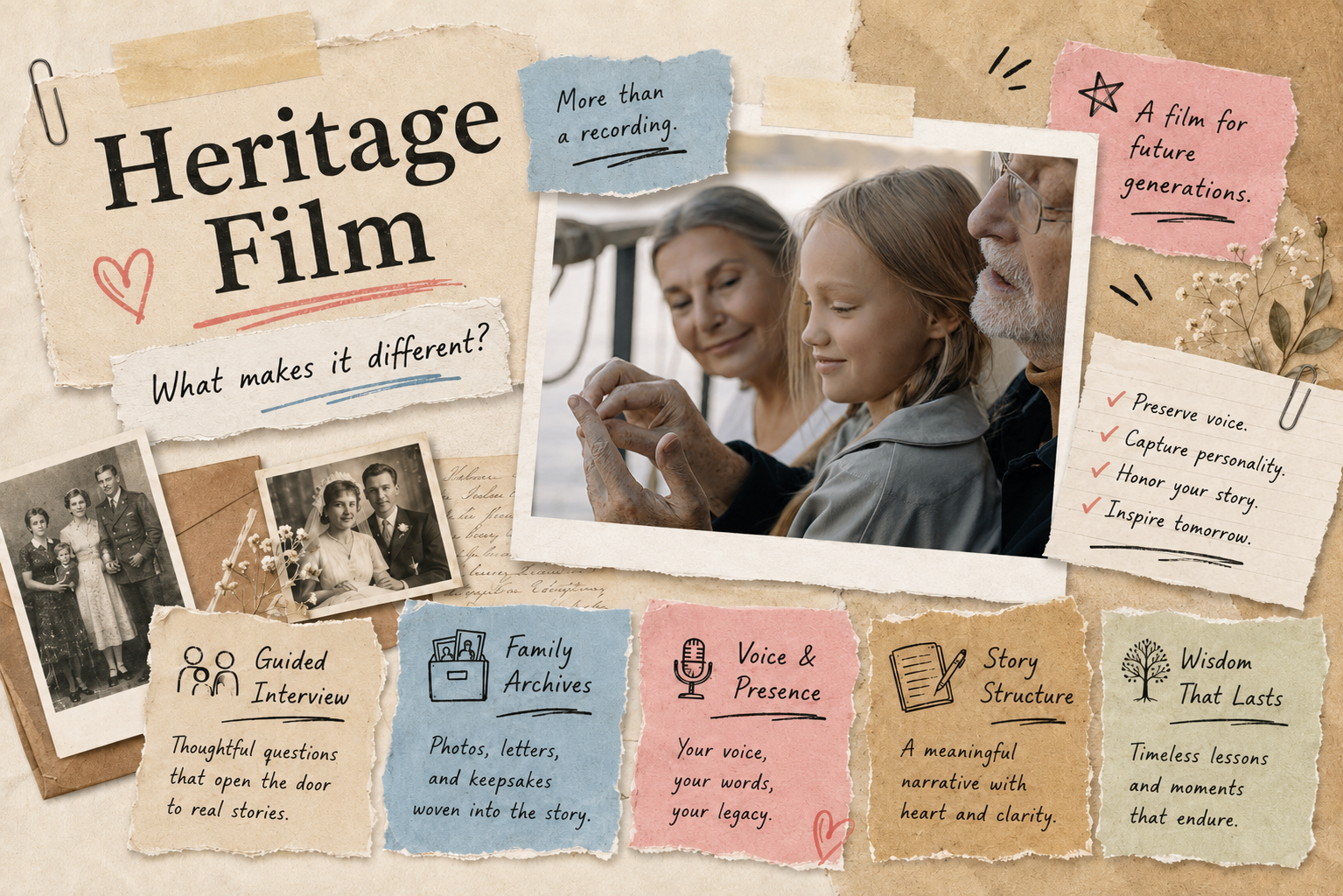
A heritage film is easy to misunderstand until you feel the difference.
Most families already have some kind of record of the past. They have old photos in boxes, home videos on tapes nobody can play anymore, names written on the back of pictures, maybe a few stories that get told at holidays when someone brings up the right person.
That is all valuable.
But it is not the same as a heritage film.
A heritage film is not just footage of a family member talking. It is not a slideshow with music. It is not a highlight reel of birthdays, vacations, and anniversaries. A true heritage film is a crafted documentary that preserves a person’s story, voice, values, memories, and hard-earned wisdom in a way future generations can actually understand.
The simplest way to say it is this:
A home video records what happened. A heritage film explains why it mattered.
That distinction changes everything.
A heritage film is built around story, not just memory
Imagine a family going through boxes after their grandmother moves out of the house she lived in for 40 years.
They find a photo of her standing in front of a small white home with two children beside her. Everyone recognizes the kids. Everyone knows the house. But then someone asks, “What was life like for her back then?”
The room gets quiet.
They know the facts. They know the address. They know roughly what year it was. But they do not know what she was carrying in that season. They do not know how hard money was, what she hoped her children would remember, what she was afraid of, or what that house meant to her.
That is exactly the kind of gap a heritage film is designed to fill.
A strong heritage film does not simply collect memories. It gives those memories structure. It helps someone move through the chapters of their life in a way that creates meaning for the people watching later.
Childhood, family, work, marriage, parenthood, loss, faith, sacrifice, mistakes, turning points, and lessons all become part of one larger story: the story of how a person became who they are.
Without that structure, even meaningful memories can feel scattered. With it, a family begins to see the shape of a life.
The interview is the heart of the film
The defining feature of a heritage film is not the camera. It is the interview.
A camera can record someone’s face. A good interviewer helps reveal the person behind it.
Most family interviews get stuck because the questions are too big or too vague. Someone asks, “Tell me about your life,” and the person being filmed suddenly has to summarize 70 or 80 years on the spot. That is a nearly impossible question to answer well.
A heritage film works differently.
The interview is guided. It follows the subject’s life, but it also listens for the emotional doorways inside each story. When someone says, “We didn’t have much growing up,” a good interviewer does not simply move to the next question. They ask what that actually felt like. They ask who helped. They ask what that season taught them. They ask what the family should understand about it now.
That is where the real story begins.
The best moments are often not the ones people plan to share. They are the pauses, the small details, the unexpected laugh, the sentence that suddenly explains a whole season of life.
A heritage film creates space for those moments.
It preserves voice, presence, and personality
A written family history can preserve facts. A photo album can preserve faces. But a heritage film preserves presence.
That matters more than most families realize until they no longer have access to it.
It preserves the way your dad tells a story. The way your mom smiles before she says something funny. The way your grandparent pauses when remembering someone they loved. The sound of their voice giving advice. The expression on their face when they talk about a hard decision, a proud moment, or a memory they have carried for decades.
Those details cannot be recreated later.
A heritage film gives future generations more than information. It gives them the feeling of sitting in the room with someone they may never get to meet.
That is one of the reasons this kind of film becomes so valuable over time. The older the film gets, the more irreplaceable it becomes.
It uses family archives as part of the story
Old photographs, home videos, letters, keepsakes, journals, and meaningful locations are not decorations in a heritage film. They are evidence of a life.
A good heritage film uses those materials to deepen the story.
When someone talks about their childhood home, the film can show the old photo. When they describe their wedding day, the image appears in the context of their voice. When they talk about a parent, a military uniform, a first business, a family recipe, or a place that shaped them, those visuals help the viewer feel the memory instead of only hearing about it.
This is where a heritage film becomes different from a simple interview.
The interview provides the heart. The archival material gives it texture, time, and place.
Together, they help the next generation understand not just what the family looked like, but what the family lived through.
It passes down values, not just events
The deepest feature of a heritage film is that it preserves wisdom.
Dates matter. Names matter. Places matter.
But the real inheritance is often underneath the facts.
What did this person learn about work? What did they believe about family? What did hardship teach them? What regrets shaped them? What values did they hope would continue? What advice would they give to the grandchildren and great-grandchildren who may one day watch this film?
That is the difference between documenting a life and preserving a legacy.
A heritage film should help the family understand the lessons behind the stories. It should make future generations feel connected to the people, decisions, sacrifices, and beliefs that shaped where they came from.
Because one day, the people watching may not just want to know what happened.
They may need to know what it meant.
A heritage film is made to last
A defining feature of a heritage film is intention.
It is created with the future in mind.
That means clean audio, thoughtful lighting, stable cameras, careful editing, organized photos, and a final film that can be watched and shared by the family for years. It also means the subject is treated with dignity. The film should not feel rushed, awkward, or like someone was simply placed in front of a camera and asked to perform.
The process should feel comfortable. The final film should feel personal. And the finished piece should be something the family returns to, not something that gets buried on a hard drive.
At Story & Legacy Films, this is the kind of work we create. We guide people through a relaxed, filmed conversation that uncovers not just what happened in their life, but what it taught them, why it mattered, and what wisdom their family should never lose. Then we weave in family photos, memories, and meaningful details to create a cinematic film designed to be kept for generations.
A heritage film is not just about remembering the past.
It is about giving the future a way to understand it.
If this is something you have been thinking about, fill out the form below. We can talk about who the film would be for, what stories you want preserved, and whether a Story & Legacy Film feels like the right fit for your family.