
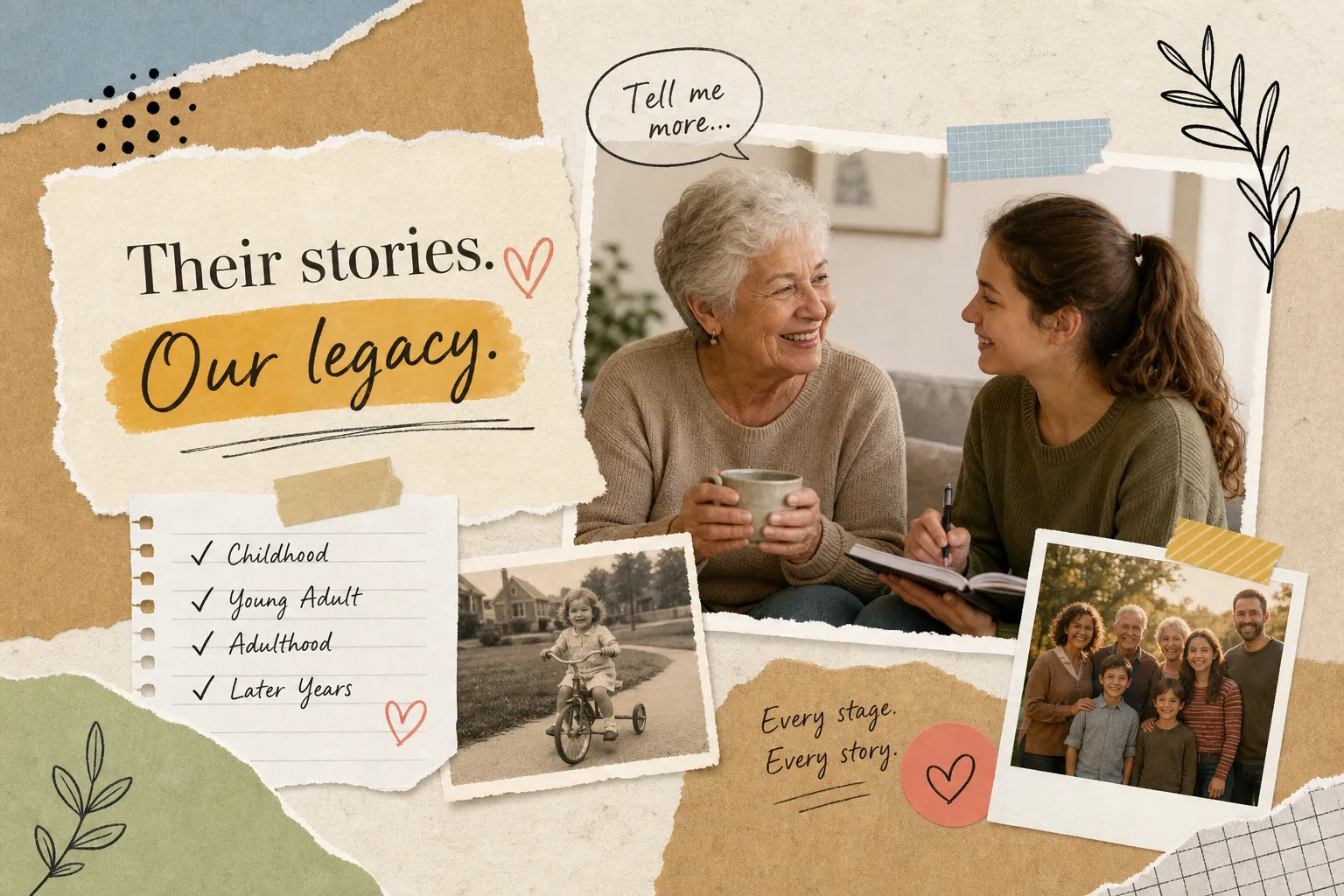
Your grandmother knows exactly what her mother's kitchen smelled like on Sunday mornings. She remembers the name of the boy who broke her heart at seventeen, the exact moment she knew she'd married the right person, and the fear she felt the day everything changed.
That knowledge lives only inside her. No book holds it. No archive has it. And once she's gone, many of those memories go with her, unique, first-person recollections that become nearly impossible to recover.
Most people feel that urgency but don't know where to start. That's where the right family history interview questions make all the difference. Generic prompts like "tell me about your childhood" get met with a shrug and two sentences. The conversation stalls. Everyone feels vaguely frustrated. You drive home with almost nothing.
Families who've sat down with a skilled guide like Kedrick at Story & Legacy Films often describe that conversation as the best one they ever had, and the difference usually comes down to the quality of the questions asked.
This guide gives you 50+ carefully organized family history interview questions to use across every stage of a person's life, plus how to structure the session, record it properly, and get answers that actually sound like the person you love.
Why open-ended questions change everything
Before you look at a single prompt, understand this: the way you phrase a question determines whether the door opens or closes. A yes/no question is a conversation killer wearing a friendly mask. It gives your relative an exit, and they'll take it, not out of reluctance, but because you handed it to them.
The difference between closed and open prompts
Consider these two versions side by side.
Closed: "Did you have a hard childhood?"
Open: "What did a typical summer day look like for you growing up?"
The second version triggers sensory memory. It asks the brain to reconstruct a scene, not deliver a verdict. That reconstruction is where the real story lives. Your job is to open rooms, not ask people to rate them.
Follow-up prompts: the secret weapon
The best interviewers listen more than they ask. When someone shares a fact, the follow-up is what transforms it. A few prompts that work in almost every situation:
- "What did that feel like?"
- "Who was there with you?"
- "What happened right before that?"
- "Can you give me an example?"
These short questions signal that you're genuinely curious, not just collecting data. You'll see follow-up suggestions woven throughout the sections below.
Family history interview questions: Childhood and early life (1-15)
These genealogy interview prompts reach back to a version of your relative that no one in the family has ever really met, the child they were before they became a parent, a grandparent, or the person you know. That alone makes this section feel like a gift.
Home, family roots, and the world they grew up in
- What did your childhood home look like, and what was your favorite room in it?
- If I walked through the front door of that house right now, what would I see?
- What did your neighborhood feel like to grow up in?
- What traditions did your family keep every year, no matter what?
- How would you describe your parents' personalities?
- What was your relationship with your siblings like?
- What was a typical weekday like for your family when you were small?
- What did your family do when times were hard?
Follow-up to try after Q5: "Which parent are you most like, and does that surprise you?"
School years, friendships, and early identity
- What was school like for you, and who were your closest friends?
- What were you known for among your classmates?
- Who was your favorite teacher, and what made them stand out?
- What is an early memory of feeling genuinely proud of yourself?
- What is an early memory of feeling embarrassed or out of place?
- What was your very first job, and what did you learn from it?
- Who influenced you most during those years, and how?
Interviewers often find that these ancestor interview questions produce the most surprising answers. People rarely get asked who they were before adulthood, and many light up when someone finally wants to know.
Career, milestones, and relationship questions (16-35)
These are the prompts that reveal a person's character: the choices they made, the chances they took, and the people they chose to love. Oral historians consistently find that adulthood questions produce the most emotionally layered answers, and these family interview questions are no exception.
Work, purpose, and the roads not taken
- How did you choose your career, or how did it choose you?
- What did you want to be when you were a child, and how does that compare to what you actually did?
- What was your proudest professional moment?
- What was the biggest risk you ever took in your working life?
- Tell me about a time you failed at something important. What did you learn?
- What did work mean to you beyond a paycheck?
- What opportunities did you pass on that you still think about?
- Did your family support or discourage you in your career path?
- Who helped you develop your skills the most?
- Would you choose the same path again?
Follow-up to try after Q20: "If you could go back, what would you tell yourself on the first day?"
Love, marriage, and building a family
- How did you meet your partner, and what was your real first impression of them?
- What were the early years of your relationship like?
- How did you navigate the hardest stretch of your marriage or partnership?
- What did you learn about yourself from being in that relationship?
- What did parenthood teach you that you didn't expect?
- What do you wish you'd known before you became a parent?
- How did your family change you?
- What did you want your children's childhood to feel like?
- What do you most want your children and grandchildren to understand about that season of your life?
- What is a story from your family life you hope never gets forgotten?
These elder interview questions often unlock emotional depth that surprises both the person asking and the person answering. The room gets quieter. People share things they've never said out loud, and that's precisely what makes oral history questions so powerful.
Family history interview questions: Values, wisdom, and legacy (36-55+)
This is the section that turns a family interview into something people return to for decades. Every person carries a philosophy they've never been asked to articulate. These life story interview prompts give them the space to do exactly that.
What shaped the way they see the world
- What do you believe in most deeply?
- Which experience in your life changed the way you think most profoundly?
- Who taught you the most important lessons, and what were they?
- Have your values shifted over time? What caused that shift?
- What do you wish more people understood?
- What traits do you think run through this family?
- What does resilience mean to you, and when did you have to use it?
- What has been the most important turning point in your life?
- What has surprised you most about getting older?
- If you could create a family motto, what would it be?
The message they'd leave if they could only leave one
- What accomplishment are you most proud of in your life?
- What would you do differently, and why?
- What wisdom would you most want to pass down to future generations of this family?
- How do you want to be remembered?
- What story from your life do you hope never gets lost?
- What would you tell your twenty-year-old self?
- What questions do you wish someone had asked your parents before they passed?
- What traditions or customs from your past do you hope continue?
- What is the most important thing you've learned about love?
- What do you want your great-grandchildren to know about you, even if they never meet you?
Save these family legacy questions for the final 15 minutes of your session. By that point, trust has been built, the conversation has warmed up, and answers will come from somewhere real. Asked cold at the beginning, these prompts can feel heavy. Earned at the end, they feel like the whole point.
How to structure and record your interview
You don't need a film crew or a production schedule. What you need is a plan, a quiet room, and the willingness to stay curious for an hour.
Building a 30- or 60-minute session
Use a simple three-part structure. Start with 5-10 minutes of low-stakes warm-up questions from the childhood section. Move into a 20-40 minute middle section following the life-stage order above. Close with 5-10 minutes of reflective legacy questions.
For a 30-minute session, prepare around 8 questions and expect to cover 3-5 of them deeply. For a 60-minute session, prepare 10-15 and plan on covering 5-8 with real depth. That's not failure, that's a real conversation. Listening matters far more than volume.
Consider using a printable interview questionnaire to keep yourself on track without staring at your phone. Print the prompts, mark your favorites, and let the list guide you loosely rather than rigidly.
Recording basics and consent
Place your phone in landscape mode on a stable surface in a quiet room with soft furnishings to reduce echo. Add an external lapel microphone if you can—audio quality matters more than video quality in a recording like this, and a simple clip-on mic makes a noticeable difference.
Shoot in 1080p, lock your focus and exposure by tapping and holding the screen, and switch the phone to airplane mode before you start to prevent interruptions.
Always record verbal consent at the beginning. A simple statement works well: "My name is ___, today is ___, and I agree to be recorded for our family archive." For recordings that may eventually be shared beyond a private family setting, a written release is worth the extra step—it can cover the purpose of the recording, who will have access, and the right to withdraw.
Back up the file the same day, ideally to both a local drive and a cloud service. A properly recorded 45-minute conversation is one of the most valuable things your family will ever own.
When you'd rather leave it to an expert
Even with a strong list of family history interview questions in hand, the hardest part is the room itself. The awkward silence. The subject who clams up. The grown child who gets emotional and loses the thread. That happens, and it's nobody's fault. It's just the weight of the moment.
Why professional facilitation gets different answers
A trained interviewer changes the dynamic. Oral history practitioners consistently find that when someone outside the family asks the questions, subjects often respond more openly, with less need to protect, filter, or manage family dynamics. They tell the funny version. They tell the version they've never said out loud before. This is what makes a guided oral history session meaningfully different from a family conversation, even a great one.
What a Story & Legacy Films session looks like
At Story & Legacy Films, every project begins with a guided discovery call to map the story before a single camera turns on. The filming uses a professional multi-camera cinematic setup with dedicated lighting and audio, designed to capture natural, unguarded conversation in a place that's meaningful to the subject.
Every question is shaped to that person's specific life, not a generic script pulled from a template. Family photos, home videos, and keepsakes are woven into the finished film so it looks and sounds nothing like a home recording.
Story & Legacy Films works with families across the country. If you've been putting off this conversation, this is one way to make sure it actually happens, and happens beautifully.
The conversation that matters most is the one you actually have
Family history interview questions are only powerful if someone uses them. The stories you want to capture are not waiting indefinitely. They exist in one person, at one point in time, and every year that passes makes them harder to reach.
Whether you sit down with your phone on a table and a printed list of these oral history questions, or you hand the project to the team at Story & Legacy Films to capture on cinema-grade equipment, what matters most is that someone asks.
Open-ended family interview questions, organized by life stage, asked with patience and genuine curiosity, can turn a single afternoon into a family legacy that lasts for generations.
Pick a date. Make the call. Ask the first question. The rest follows naturally from there.